Small Wonders – Session 9
Technology has made many things easier. But perhaps one of the quieter questions of our time is what happens to the human mind when it no longer has to do the things it once did for itself.
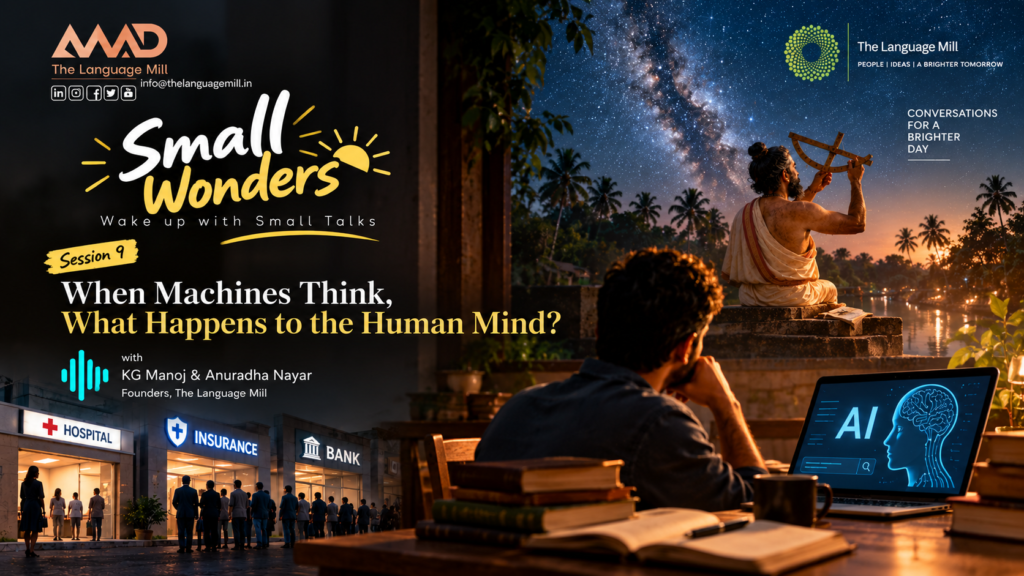
In Session 9 of Small Wonders, The Language Mill founders KG Manoj and Anuradha Nayar find themselves in a conversation about Artificial Intelligence, human behaviour and the changing relationship between people and their own capacity to think. One side of the conversation wonders whether the human brain is gradually being left with less to do, as machines calculate, search, measure and decide with increasing ease. The other sees something more hopeful—the possibility that when certain burdens are taken away, the mind may finally have the freedom to explore new pastures, new ideas and new horizons.
The conversation then moves towards the many instruments and institutions that have entered everyday life. Once, a person had to observe, imagine, calculate and arrive at conclusions through experience and reasoning. Today, devices, scales, databases and specialised institutions perform much of that work. Even decisions that once belonged closely to individual judgement and human interaction are increasingly guided by systems designed for efficiency and institutional sustainability.
This becomes particularly visible in areas such as health insurance. Institutions that were created to serve particular human needs can gradually become so focused on processes, measurements, risk and business sustainability that the human connection begins to shrink. The observation leads to an interesting comparison: a visit to a hospital is rarely associated with a happy face. Yet banks and insurance institutions, though fundamentally different, can sometimes evoke a similar nervousness—the feeling of entering a system rather than meeting people.
The conversation reaches further back into Kerala’s intellectual history through Madhava of Sangamagrama, the celebrated mathematician-astronomer associated with the Irinjalakuda region and regarded as the founder of the Kerala school of astronomy and mathematics. Historical sources describe his remarkable mathematical and astronomical work, including methods for calculating astronomical quantities and his pioneering work with infinite series.
The contrast is striking. A mind once looked at the night sky and worked patiently towards understanding its patterns; today, a question about the stars can be typed into a device and answered almost instantly. The difference is not simply between the past and the present. It raises a more fundamental question: when knowledge becomes instantly available, will curiosity become weaker – or will the human mind finally have the freedom to ask better questions?
Perhaps Artificial Intelligence need not mark the end of human thinking. It could instead become an invitation to move beyond the calculations and routines that once consumed so much of human energy—to imagine, question, create and explore what lies beyond the answers already available.
A small conversation about Artificial Intelligence, human behaviour, forgotten ways of thinking and the possibilities that open up when the human mind is given something new to explore.
Small Wonders – Wake up with Small Talks.
A programme from AWAD by The Language Mill.