Illustrations by KG Manoj | For Sakhavum Sevakanum by Kavalam Sasikumar
Some illustrations do more than interpret a story. They create another language through which the story can be experienced. The seven illustrations created by KG Manoj for Malayalam writer and poet Kavalam Sasikumar’s recently released book, Sakhavum Sevakanum, belong to this realm. They are realistic in their visual treatment, yet abstract in their conception. Rather than illustrating a sequence of events, they explore the underlying relationship between two friends whose ideologies may differ, but whose personal bond remains intimate.
At the centre of this visual narrative is a humble object deeply rooted in Kerala’s cultural memory: the Kalasham, a traditional earthen vessel. Its significance extends beyond its everyday function as a container. It also occupies a place in rituals and the passage from life to death. In the final rites, the vessel carrying the remaining ashes becomes part of a journey towards the sacred rivers and, ultimately, the sea. It is an image of departure, dissolution and return.
In these illustrations, the Kalasham is never merely a prop. It becomes a silent participant, appearing in different forms and relationships with people, nature and architecture. Its meaning is never explicitly stated. Instead, it quietly travels through the illustrations, allowing the viewer to discover personal interpretations.
The seven works – Ore Vazhi, Vaadaprathivaadam, Urakkallu, Sauhrudam, Nervazhi, Model and Gramam – form a visual sequence in which friendship, disagreement, growth, continuity and change find expression through familiar objects and unfamiliar associations.
Ore Vazhi – Two Lives, One Journey
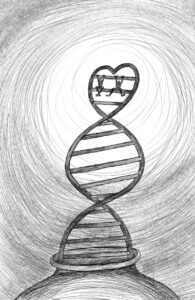
The title Ore Vazhi (The Same Route) introduces the central idea of the series through the form of a DNA structure. Two friends rest on one of its horizontal bars, suspended within a structure that suggests both connection and separation.
The DNA strand is a natural metaphor for shared origins and an intertwined existence. Yet the two friends are not identical. They occupy the same space, but their individual thoughts and convictions may take them in different directions. The illustration brings these seemingly contradictory ideas together in a single, simple composition.
The horizontal bar becomes a temporary resting place in their journey. They may disagree about the road ahead, but they continue to share the same larger passage. The image does not attempt to resolve their differences. It simply allows them to coexist.
Vaadaprathivaadam – The Space Between Two Opinions
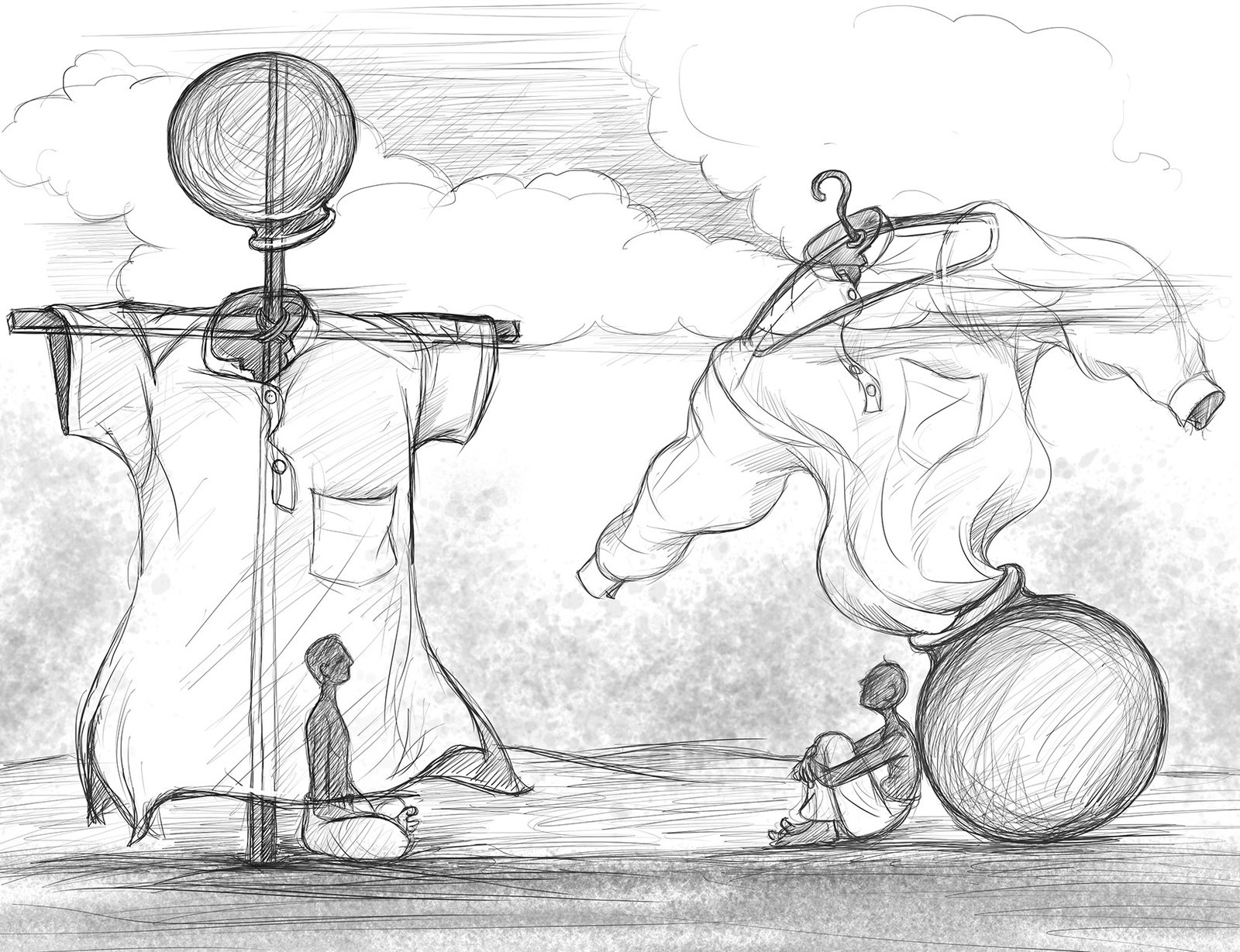
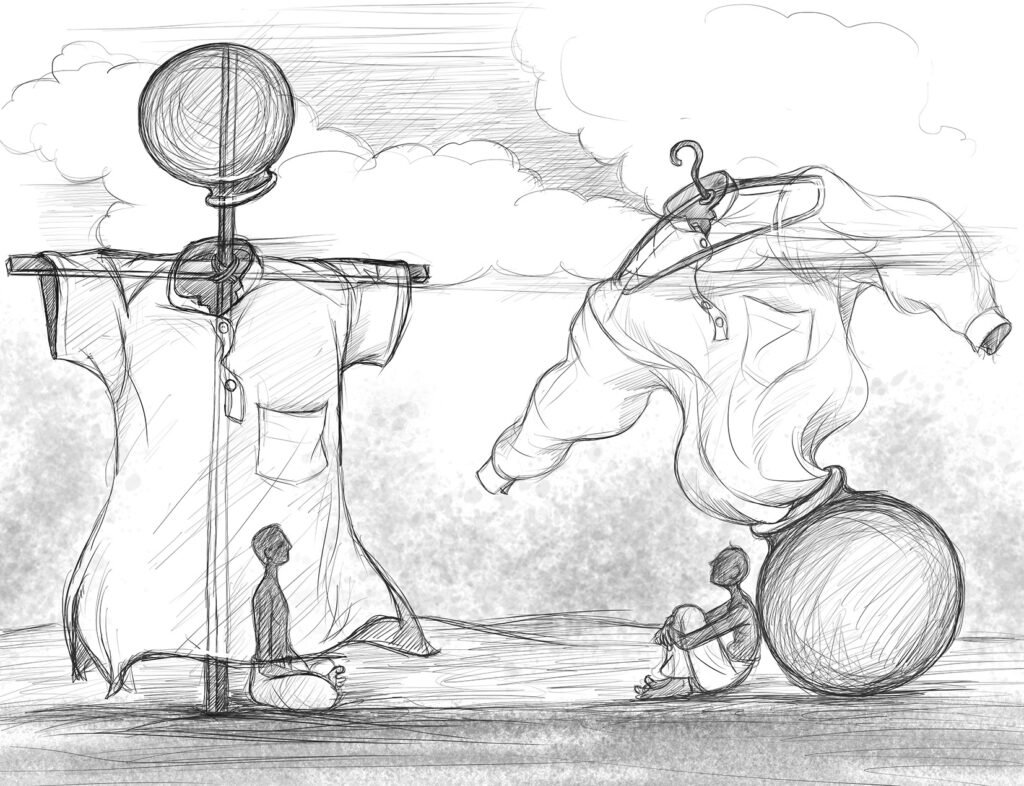
In Vaadaprathivaadam (Argument and Counterargument), the two friends sit facing each other, bringing their differences into direct confrontation. One character is partially concealed beneath an oversized traditional garment, while the other sits beside a large Kalasham where the charactered dress comes out from the Kalasham. The hanger plays a role against to the Kolam stand as a counter arguement.
The composition draws on a familiar visual memory from Kerala’s rural traditions. The Kolam, a folk structural figure associated with agricultural protection, often features a painted face on an earthen pot used as its head. The illustration subtly recalls this cultural imagery without reproducing it literally.
The oversized garment becomes a visual extension of the character, suggesting a personality that is partly revealed and partly concealed. The Kalasham, meanwhile, stands as a quiet presence between the two. It does not take sides or interrupt their exchange.
The result is a scene in which the argument is visible, but its subject remains open to interpretation. The viewer is left to consider whether the disagreement is a barrier between the friends or simply another way in which their relationship expresses itself.
Urakkallu – The Weight of Opposing Thoughts
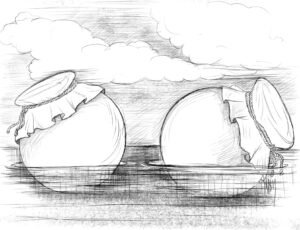
In Urakkallu, the traditional Kerala grinding stone becomes the starting point for an unusual composition. Two Kalashams, covered with cloth and tied securely around their necks, face in opposite directions.
The Urakkallu is an instrument of preparation, where ingredients are crushed and transformed into something that sustains life. Here, however, the vessels remain closed and turn away from each other. Their covered forms conceal whatever lies within, much like the thoughts and convictions that people hold close to themselves.
The composition suggests two individuals carrying their own beliefs, histories and experiences. They may be part of the same relationship, yet their perspectives remain different. The opposing directions create a visual tension, while the familiar objects lend the composition a distinctly local character.
There is no obvious resolution. The image leaves us with the possibility that differences can remain, even within a lasting relationship.
Sauhrudam – The Language of Friendship
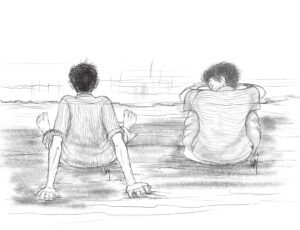
Friendship does not always need words to establish its presence. In Sauhrudam (Friendship), the two characters occupy different positions, each with a distinct posture and expression. Their physical gestures become the language of the illustration.
The composition moves away from the more overt symbolism of the other works. Instead, it brings the relationship into focus through the individuality of the two figures. Their postures suggest different temperaments, perhaps even contrasting ways of looking at life. Yet they belong together within the same visual space.
The simplicity of the scene is its strength. Friendship is not presented as an agreement of minds or an absence of conflict. It is a relationship that accommodates individuality, differences and the occasional silence between two people.
The illustration captures this companionship without needing to explain it.
Nervazhi – The Unintended Journey
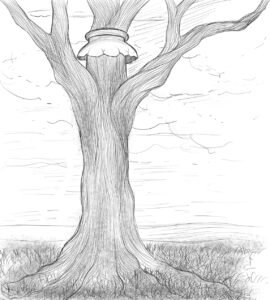
In Nervazhi (The Direct Path), a grown tree becomes the central element of an intriguing visual metaphor. Its trunk grows through a Kalasham, whose neck encircles the tree. The vessel, however, is broken at its base.
The image reverses the familiar relationship between a tree and the objects surrounding it. Here, the vessel appears to have become part of the tree’s growth, almost as though it has been carried upwards without knowing it.
The tree represents a natural process of growth, while the Kalasham introduces an element of human intervention. Its broken base suggests that the vessel has lost its original purpose, even as it remains attached to something that continues to grow.
There is an ambiguity in this relationship. Is the vessel being carried forward by the tree, or has it become an obstruction to its natural growth? The illustration offers no answer. Instead, it creates a quiet reflection on the ways in which beliefs, traditions and inherited ideas travel through generations, sometimes changing their meaning along the way.
Model – The Architecture of Aspiration
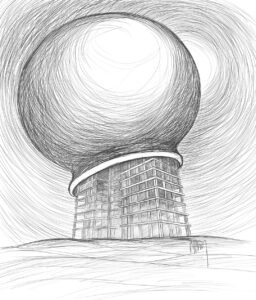
Model presents an under-construction skyscraper, its rising structure covered at the top by an enormous Kalasham. The contrast between a contemporary architectural form and a traditional earthen vessel creates an unexpected visual encounter.
The skyscraper represents ambition, construction and the continuous human desire to build something beyond what already exists. The Kalasham, on the other hand, carries associations of tradition, memory and cultural continuity.
Their unusual relationship introduces a question about the foundations on which progress is built. Does the past continue to shelter the present? Or does tradition, in its attempt to protect what is being built, become an overwhelming presence?
The illustration does not impose a particular interpretation. Its strength lies in the scale and placement of the two elements. A familiar vessel becomes monumental, while a towering modern structure appears almost vulnerable beneath it.
It is a visual dialogue between the inherited and the emerging, between what we carry forward and what we are trying to create.
Gramam – Between Nature and the Built World
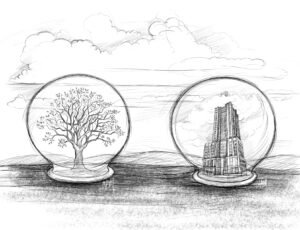
In Gramam (Village), the Kalasham returns in a different context. Two compositions bring together a tree and a building, representing two distinct structures: one shaped by nature and the other by human hands. Both are covered or sheltered by the familiar vessel.
The tree and the building become complementary images of existence. One grows through natural processes; the other takes form through human intention. Yet both are subject to the passage of time and the changes that accompany it.
The Kalasham, placed above these structures, introduces a sense of continuity. It can be read as a symbol of preservation, but its presence also raises questions about the changing relationship between tradition and modernity.
The village is not presented as a static landscape. It is a place where nature, architecture, society and human thought constantly interact. The two compositions suggest how different ways of life can coexist, even as each undergoes its own transformation.
A Common Vessel, Many Interpretations
Across these seven illustrations, the Kalasham gradually moves beyond its identity as an object. It becomes a connecting element, appearing alongside the human body, a tree, a grinding stone and a skyscraper. Its presence links the intimate world of friendship with the larger questions of society, tradition and change.
The sequence also reflects the distinctive relationship between realism and abstraction. The figures, objects and settings are drawn with a recognisable sense of form and detail. Yet their arrangement belongs to an entirely different visual language. Familiar things are placed in unfamiliar situations, encouraging the viewer to look beyond their immediate appearance.
The illustrations do not attempt to narrate the book through literal scenes. Instead, they create a parallel visual experience, one that allows the reader to approach the relationship between the two friends through images rather than explanations.
The most compelling aspect of this approach is its openness. The two friends remain together despite their ideological differences. Their disagreements are neither erased nor exaggerated. They simply form part of a larger relationship that continues to exist.
Perhaps that is where the Kalasham finds its deepest significance in this series. Like a vessel that carries something through different stages of existence, it accompanies these characters through their own journey. Its final destination is never shown, and its meaning is never fixed.
The illustrations leave us with the same question that friendship itself often poses: how can two people travel together without necessarily thinking alike?
In Sakhavum Sevakanum, KG Manoj’s illustrations offer a visual response—not through conclusions, but through the quiet poetry of form, gesture and symbolism.